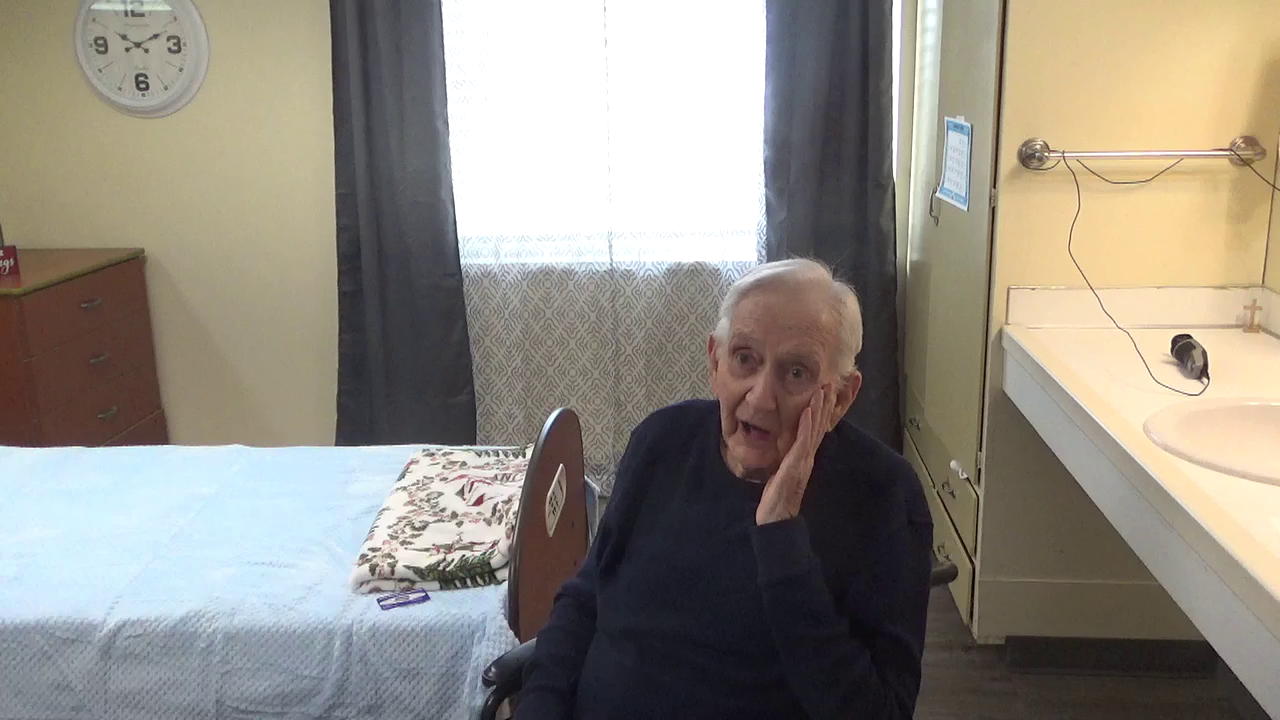
The following story is the result of a video interview that was obtained by multiple American Legacies Org volunteers at a Nursing Home type health facility. It has been edited, to take out certain information that could become a security risk. Upon the passing of this individual, that additional information will be restored, so current and future family members will have access to it. We have attempted to keep the language original to his dialect, in order to keep this transcription authentic.
If you have a loved one that you would like interviewed, documented and preserved for future generations, please contact us via our website at AmericanLegacies.org. Our services have been available and 100% FREE since 1996.
******************************************************
My name is William Wilson. And I was born on July the 4th, in Kentucky.
This is the second time I’ve been here at this Healthcare facility. I've been here since September, I guess. The food here is good. I'm a country boy, so my favorites are meat and potatoes.
My father’s name was Arthur. He was born in the same area. He was born in 1905.
I don't know when my grandfather was born, but his name was Luther. He owned a sawmill. I never worked around the sawmill with him. He died when I was about eight or nine years old. His wife was Sarah Arnold. She was from that same area. She died before I was born.
My mother's maiden name was Cook.
My father was a farmer. He growed tobacco and corn and, you know, the usual stuff. I helped him on the farm. It was hard work, but everybody was in the same boat, you know, and so we never thought nothing about it.
I was eight or ten years old when we got our first radio. World War II was going on. The war ended, I believe, in 46. And so I was quite young still when the war ended. But I remember stuff being rationed.
As a matter of fact, I think I still got a ration book someplace. Our radio, it was battery operated, we didn't have electricity. When the battery died. We just got a new one. I'd say it was a good size battery, about 20 by 6 by 6.
We didn't have an icebox or a refrigerator. We put our milk and butter in the well. That's how we kept it. And anything else, you know, we couldn't. Well, there weren't no leftovers anyways.
There was five of us. And so we eat it all up.
For transportation we had two horses to pull a wagon. And the store was about a mile away. And we would just load up the wagon, it had spring seats, and go to the store.
I had two brothers and two sisters. I'm the middle boy. I had two older sisters. I was the middle boy. And they're all deceased except my youngest brother. He's three years younger than I am.
We had a wood burning cook stove. And our heat was with wood, and I had to help cut the wood. I was 12 years old before I learned my name wasn't ‘Get Wood.’
Our house was made of wood. And the walls had wallpaper on them.
My dad went to Louisville and got a job in a factory called Shooter Raxlet Company. I would take my mother to the store in the wagon. I was probably 13.
He get back and forth to Louisville with friends or on a combustion engine bus.
I served in the Army. I spent two years at the Army Intelligence Center, in Baltimore, MD. I was rank E4 when I got out.
I was, let’s see, I believe I was 26 when I got married. I was married 20 years the first time. And I've been married the last time for 38 years. My first wife worked at a store where my brother worked, and I met her that way. Her name was Wilma Ruth.
I had three children. And the oldest one is deceased. He passed away when he was 30 years old. He went to work one night and had a massive heart attack. Big, strong guy. Did too much. I have two children that's alive, and one grandson, no great-grandchildren yet.
And I went to work at the same factory my dad worked at, Shooter Raxlet Company. Well, after that, I went into service. And when I come back, I went back to that same job for a while.
And then I went to work for Thomas Industries in Beaver Dam. And I worked there for 20 years. They made lighting fixtures.
For a hobby I was a woodworker. I mostly made furniture. I made some toys. Of course, my dad, he was pretty good with his hands and he taught me some, but no formal training.
Some of the most exciting times of life were probably when I was in the military. I'd never been away from home, you know. And there was a bunch of young guys like myself. Most of them have never been away from home. So I guess that's about a lot of new experiences, exploring the world, outside of your hometown.
Of course, Baltimore is a big city. I wasn't used to that. Well, I spent some time in Louisville, you know, before I went into the Service. But it was a lot different, a lot different.
The first car that I had was a 1950 Mercury. I worked for my uncle on the farm and saved up a little money. I think I give $100 for this car. It was blue when I got it. I painted it in black.
First dance that I went to was when I was in the military. It was a service club that had Dances.
Dad had the farm. Outside of taking care of your livestock and whatnot. Of course, we had my mom and my brothers and sisters. We could do that while he was working, you know.
So he would stay in Louisville through the week, come home on the weekend.
He transitioned from a team of horses to a tractor in the 50s, 1950s. He got his first tractor in the 50s.
And he got his first automobile about the same time, in the 1950s. His first vehicle was a Plymouth. I believe a 46 Plymouth.
We had livestock on the farm. We had horses and cows and pigs and chickens. That's pretty much it.
After he retired from the job in Louisville, he moved back to the farm. He eventually sold that farm and bought another one, in the same area.
I'd say he worked at the factory in Louisville 10, 12 years, And it wouldn't, he'd get laid off, you know. The work would go down and he'd get laid off. Of course, he'd come home and work on the farm until they called him back.
I was still in elementary school. They'd have movies in the gymnasium once a week. And a farmer had a cattle truck with racks on it. And he go around and pick us all up, in the back, like a bunch of cattle, and haul us up there to the movie.
I remember one of them was a serial, and it was two Boy Scouts lost in the jungle. And, you know, every week they'd have another version of it. And this went on most of the summer, you know. People today don't even know what a serial is as far as movie type.
Probably not. Of course, they had the serials on TV, you know, but movies, no. I was a teenager, I was probably 14, 15 years old when we got our first TV. We never got electricity until I was in high school. I was like a sophomore in high school when we got electricity. So, you know, that followed then, of course.
I was in my late teens, I'm saying, when we got indoor plumbing. It was a full bath.
We didn’t have running water in the kitchen until we got electricity. Okay.
Well, we hired somebody to put in the plumbing. I helped the guy do it as a part of the deal. I wasn't no plumber, but I was a gopher, you know. Like crawl under the house.
Of course, my fondest memories are when my kids were born.
I played card games and board games with them. We didn't have a whole lot of time for games. We were working too many hours.
When I was a kid, we would play games like hide and seek and, you know. And it had where we would throw the ball over the house, you know, have so many on one side and so many on the other. Just games we made up, you know.
I played sports in high school. Well, in grade school, too. I played basketball and baseball. Well, I was first string. They didn't offer... That's all the sports they offered in school here at that time. I went to a school called Horse Branch. Horse Branch, they were called K through 12 school. Well, in 1950, our school burnt.
I stood and watched it burn down. And then they lined us up and put us in churches. And I went to a church and there was, I believe, four grades went to that school for, I guess, two years until they got a new school built.
Well, they were working on a new school when the old one burnt. So it took another year or so to finish it up. The old school that burned had electricity. And it had an outhouse.
I don't know. I don't believe it had running water. The desks had the ink well. They had the old place where the, you know, where you could put it. The desks still had it. They didn't use them anymore.
We used pencils. And then the ballpoint pen come along. I don't remember what year it came about. But I was probably in high school when the ballpoint become plentiful, you know. They were kind of scarce for a while.
I had several uncles. Uncle S. Uncle Ode. Uncle Grood. Uncle Bill. There was 15 in my dad's family. So I had a bunch of uncles. Some of them I didn't know because they died before I was born.
I had one uncle on my mother's side. And his name was Corgus. Corgus Cook. Her mother passed when she was about a year old or something.
So she had a stepmother and had the son and daughter. That's where I got that aunt and uncle on her side.
Mother was an excellent cook. Some of my favorite foods that she cooked was cornbread and beans. For breakfast we would have bacon, you know, bacon and eggs and gravy and biscuits.
My dad was a pretty good cook too. He was early riser and sometimes he would have breakfast ready when my mom got up.
We butchered our own hogs. I've helped do that too.
I've helped make lard. To make lard, you take the fat off of the hog, usually on the sides, and you cut it up into cubes, about three-quarters of an inch by three-quarters, and put it in an iron kettle. And we had a little stone that the kettle would fit on, and wood burning, and you just build a fire under the center of your stone, of course, even scorching. And it'd take a while, but... A kettle full would take a couple of hours. It was sort of a deep-fried something, you know. After all those cubes were starting floating, I worked all the (unknown) out, right out of it. And we just skimmed them off, put the lard in a can, put on another batch.
We didn't kill beef. Pork and chicken were the meats we had. We never had beef until later on we'd buy it at the store, you know. The cattle were milk cows. And, of course, you'd raise a calf, usually sell the calf. We produced more eggs than we could use, so we'd sell them. The store would buy those. Or you could even take your hens down there. You'd sell the chickens too, if you wanted to.
To transport the eggs we would put a towel in there and kind of wrap them up.
we raised cucumbers, that was a cash crop, and a hard job picking them.
We raised tobacco, of course you take that to an auction house when it was ready to sell,
We grew most of our own food. My mother would can it, and she would can sausage, and you just open it up, heat it up, you're good to go. That was the best sausage I ever eaten, I guess.
She stored the canned food in some closets in the house with shelves. We buried the potatoes. Well, you dig up a place and put straw in there and put the potatoes in there, and then more straw and dirt, of course.
Christmas when I was a kid, we'd go out in the woods and cut us a tree, and we'd pop, popcorn and put the string in, you know. And we didn't have a lot of decorations, but we could usually buy a few icicles or stuff like that, you know, put on the tree.
We wrapped presents, mostly with whatever we can find.
My second wife, we worked at the same factory. I met her there.
I didn't spend a lot of time with my grandparents. My granddad Wilson, I remember him. My granddad Cook died before I, I can't remember him. And both my grandmothers passed away before I had a chance to know them.
I lived in Louisville for a time or two. I worked for the railroad in Louisville. L&N. And then I worked for Illinois Central. I was what they called railroad policemen or railroad detectives or whatever. And that was for L&N. I worked on a track maintenance.
Of course, we have you know, they have, they ship a lot of stuff and uh you know it's like getting out there checking the seals and see if anybody's broken into it and, uh of course, sometimes they do break into it. You try to figure out who done it.
We had one son was handicapped. His name was Jason, Jason Wilson. He had a lot of learning disabilities because the injury, he had an injury during the birth of the process. He went to school, and he didn't get a regular, you know, certificate or whatever. He did get a certificate of completing high school, and he went to work in a shelter workshop, and he'd been there about 28 years, worked at the same place. He lived with his mother after we divorced and she died a couple years ago and he lives there by himself, takes care of himself, gets up and goes to work, comes home, goes to the shop.
This is my second time here. I don’t expect to go back home. My wife is not in very good shape. She can't, you know, she can't take care of me.
Of course, I'm semi-independence, you know, there are a lot of things I can do by myself, but there's some things I can't. She just couldn't, she couldn't do that.
The first time I came here, I stayed three months and I went home. I had three falls. And when I went home from here the first time, I had a fall and hurt myself. So I decided I don't want to do that again.