BEFORE IT WAS WRIGLEYVILLE
by Mike Fak
Authors Note: I was born in 1948 in Chicago Illinois. Until 1960 I lived at 3824 North Sheffield, just a block and a half from Cubs Park. The following is a compilation of memories that for whatever reason I found myself compelled to turn into this story.
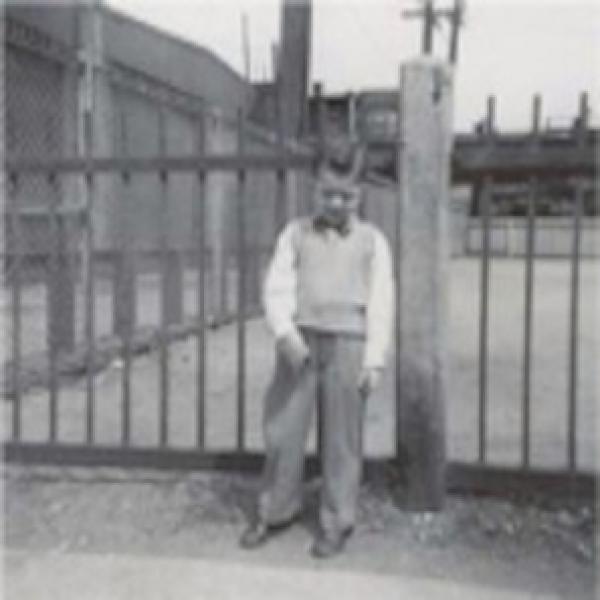
A picture of Mike Fak in 1955 outside Horace Greeley School yard.
By Mike Fak
I wrote ‘Before it was Wrigleyville’ at 2:00 a.m. after an evening of fitful dreams. No longer being able to sleep, I typed a huge jumble of thoughts and recollections triggered by my subconscious before they were lost again forever. This little grab bag of memories lay in a folder I promised to someday rewrite into a cognizant story. Every night for several years as I lay waiting for sleep to end my day, I had a pang of regret that I had not compiled, sorted and brought those pages into story form. It seemed to be of no consequence to me whether the story was any good or not. I only knew that I had to bring it to life, regardless of it having any quality or value.
In 1997, I did just that. Again on a night where sleep was a stranger to me, I took the folder out and this is how the story you are about to read came about. It is about my life as a young body growing up in the shadow of Wrigley Field in the 1950s.
In late 1998, the story again started to keep me awake. I tossed and turned wondering what it was about this simple tale that wouldn’t give my any peace. At last I decided that perhaps it was a call to me to visit the old neighborhood. I often wondered why, in 40 years, I had never gone back to my childhoods stomping ground since 1963. Not once in all those years.
It is just one of those things that from time to time happens to all of us. I had a dream about my childhood. I am not sure what exactly triggered this one. I don’t recall seeing someone I hadn’t seen in a long time. Nothing I can recall seeing in print or on the TV was the culprit. I guess it was just brought on by something I ate. Anyway, I had this dream about my childhood.
The first scene in this vision had me at Wrigley Field in the middle of a snowstorm. The half dozen friends who were with me sitting along the third base line were a compilation of many people I have met over the years.
As with everyone’s dreams, since they were not important to the text, they in a sense remained nameless as well as faceless. The point of my mind’s journey was that I was back home in my first playground. Although there was a snowstorm, the day itself was sunny and bright. I understand this is not possible, but reality has little domain in a person’s dreams.
I believe the winter storm that wasn’t cold was done for effect. There were no ballplayers on the field, nor anyone else save my small group in the stands as I sat and looked and smelled all that was Wrigley.
The fake storm had been the catalyst for the next scene, I now found myself under the stands at the corner of Addison and Clark sipping a coffee, looking in the window of the autographed baseball store, which has never been there. Baseballs with the signature of every ballplayer you could imagine were lined up stitch to stitch in the display cases. As I shuddered and sipped my coffee, an elderly clerk with glasses dangerously close to the end of his nose waved at me through the store window, beckoning me inside. Walking into the brightly lit store, the dream changed again. The small store was now empty except for a single glass case on a walnut pedestal in the center of the shop. In the case was a single baseball with the autograph of Ted Williams perfectly discernible across its face.
I recall having no surprise at the ball carrying the Splendid Splinters name. Ted Williams was my favorite player over all the hall of fame players I saw in Wrigley Field during the late 50s and early 60s. That might seem strange since I never saw him play. My opinion based on memories of my dad having family arguments or just preaching to me about Ted being the best ballplayer ever convinced me Williams was the man.
I recall my dad saying that if Ted hadn’t given up five years of his career to serve his country in World War II and Korea, that his career totals would have been unsurpassed. I was a young boy. He was my father and his word was gospel. My favorite player, like dad’s, had to be Ted Williams.
Staring at the special baseball, I noticed a card requesting $200.00 from whoever wished to purchase the souvenir. As I stared at the perfect signature, a hand rested upon my right shoulder. Forget it kid. That’s way too much to pay for that ball. As I turned to see who was talking to me, the dream shifted into the third person.
I watched from a distance as I became a young boy again, standing and talking to Ted Williams, my hero. Without explanation (which is never needed in a dream), I saw myself walking away with Mr. Williams.
I knew as I watched the two of them leave the ballpark that they were going somewhere to talk about my youth around good old Wrigley. With their backs turned to me, I heard myself say to Ted, You were my dad’s favorite ballplayer. I know. He replied. As the two figures dwindled in the distance, I saw the young boy reach to hold the mans hand. Gently, you could see the older man return the gesture.
Within a moment, a completely new illusion had formed in my dreamful mind. I was sitting on a sofa in a room that carried no substance. It was like no room I had ever been in, yet it was similar to all the rooms I had called home in my life. Ted Williams was sitting in front of me on a straight back chair, with hands folded, his body hunched over towards me. I felt like I was being questioned by a doctor about some malady I had claimed to have. I kept asking Ted to tell me stories of his playing days. I wanted to know if he really could pick up the rotation of a ball as it left the pitchers hand. Could he really know if it was a fastball or a slider or a curve like people said he could? I wanted to know what went through his mind that last day of the season, when batting 400; he refused to sit out the last doubleheader games of the season and went 6 and 8 at the plate. All my questions to Ted were brushed aside by him. For every question I asked, he said, No, I want you to tell me about your days in the old neighborhood first.
Suddenly the point of my dream became obvious. All of us have things locked in our minds since childhood. Things that we remember but never have had occasion to recall. Some of those memories are sent into deep corners of our mind because they were sad or hurt to remember. There are many good events that have been tucked away in corners of our recollection. These thoughts have helped shape our life’s character, yet have become lost in the innumerable files of memories past. A thousand of these little vignettes of my youth now came forward to be recounted. Things I thought I had forgotten as well as things I had forgotten that I ever remembered now came across my minds eye.
I recalled the old neighborhood explicitly. I mean to the point that I could draw you a detailed map that would be 100% accurate. Every building, every store, every nook and cranny of the one mile radius around Wrigley Field was there for me to see. Each element, like a miniature film that carried its own story to tell, one after the other, flew before me.
The neighborhood was and is made up of innumerable six flats called brownstones or greystones built within a few inches of each other or in some cases having no space between them at all. This strange trait had caused gangways to be cut through the underbellies of the apartment buildings so that residents could go from back yard to front steps without having to walk all the way around those long city blocks. In some areas homes rested comfortably a few feet from each other but that was not the case on the thirty eight hundred block of Sheffield which was lined almost entirely with six flats on the west side of the street.
I remembered the hotel Carlos in the middle of my block on Sheffield. I recalled Mom telling me not to go in there trick or treating at Halloween because the hotel was full of transients. The word scared me. I never asked what it meant.
I thought back to the busy corner where Sheffield turned into Sheridan Rd. as a person heads north. The tough Irish cop who was there every morning and afternoon to help school kids cross the intersections, ruled the corner like a feudal tyrant. Step off the curb before he waved you on and you would find him crouched down on his knees, his face in yours asking you, Who told you to step in the street? You wait till I give you the signal to cross or I’ll whack you on the noggin with my nightstick. All of us got yelled at once a year. None of us got lectured twice. As we crossed the street thoroughly scared, the old cop would rub us on the head and tell us to do a good job in school.
Our quick movement crossing the street would cause the hundreds of pigeons on the huge sidewalk to get spooked enough to take flight momentarily until the leaders of the flock would signal that it was alright to land again and return to checking the area for food scraps. The neighborhood was filled with families but the pigeons outnumbered us ten to one in those days. I recall how everyone in the neighborhood just considered so many big birds as part of life on the near North Side of Chicago.
The memory of my walking down Sheridan in my brand new black suit going to my First Holy Communion came back to me. Proudly walking the four blocks to church I remember a lesser mannered pigeon dropping his waste on the left shoulder of my brand new suit. I remember that being the first time in my life that I cursed out loud.
The next memory on Sheridan going to school was Hanovers Delicatessen. They had a son my age names Larry. He didn’t go to St. Mary’s with the rest of us because he was Jewish, but he was a great guy and was still part of the gang. Even when we were just in third grade, I remember Larry having to work around the store before he could come out and mess around with us. That was no problem. At the age of ten I had a Herald American paper route after school and so did my other buddies. A job, some type of job, was a given if you were a kid in the fifties. Want money to spend? Then earn it, was the rationale of all the families in what we then called the Near North.
A little further down the block was the old Mode theatre. An old timer even in the fifties, the Mode showed movies that my dad would say were already on that newfangled invention, the television. You could always find Foy, Fak, and Flynn in the front row on Saturdays however. That was fifty-cartoon day plus a couple Three Stooges shorts and an old movie classic like King Kong or The Creature from the Black Lagoon.
For some strange reason we always tore the popcorn boxes in a certain way so that they fit on our faces like some type of goggles. I’m sure the three of us were a strange sight. Sitting in the front row, popcorn boxes affixed to our faces as we mouthed the words to shows we had seen a hundred times before. It actually made sense back then for little kids to sit up close to the screen. Women wearing huge hats that they refused to take off in the theatre could make it impossible for a small fry sitting behind them to see the movie.
The show cost a quarter to get in. Popcorn was a dime. We drank from the water fountain to save money.
The rest of the way down Sheridan Rd. was inconsequential except for the El station just before Irving Park. Under the tracks was a great candy counter as well as the home of the second most important item in our lives, the comic book stand.
A short, gaunt man with a perpetual cigarette in his mouth always stood behind the counter. He didn’t seem to mind our spending so much time practically reading all the comic books. He knew we would never steal any of them and although we might have read the comic, we would still buy it. A good comic was worth owning and reading over and over and over again. They cost a dime back then. When they skyrocketed to 12 cents in price, we had our first lesson in inflation.
One of the only debates that put any stress on the friendships of the gang was the argument over whether Superman or Batman was the coolest superhero. Anyone who came up with Green Lantern or The Flash as their choice was quickly admonished by the rest of us.
Going down Sheridan road the next two blocks had many apartment complexes in a u shape formation. These buildings, called courtyards by us back then, made the neighborhoods still more crowded than the six flats as they allowed twice as many apartments in the same amount of space. Parking would have been a nightmare back then if every family had a car, but most didn’t. I recall never knowing anyone back then who had two vehicles.
The walk down Sheridan finally brought me to the corner where my school and church, Saint Mary of the Lake was located. I always did the last half block to school at a run because I had to first go by Konitzer-Rowland funeral home to get to the streetlight. Both grandma and grandpa Fak had been waked inside that building and I carried a great fear of the structure all my years in the neighborhood.
St. Mary’s Church was a huge classic greystone building with broad sweeping stairs leading up to its three sets of massive doors. Behind this awesome structure was the convent and beside that the school that I went to until seventh grade. I remembered how the playground was a forest with dozens of trees until a sixth grader during recess fell out of one of the trees and broke his arm. The next memory I have of the playground was nice, neat, completely harmless asphalt. I guess even back then a lawsuit here and there would raise its angry head.
The memories of my time at St. Mary’s Grammar School revolved around two events. First the news that the Russians had launched the Sputnik satellite into space in 1957 scared everyone with the thought of nuclear weapons raining down on us from the stratosphere. I recalled how we would scurry into the hallway or be told to get under our desks and put our hands over our heads as we practiced air raid drills all the time. I remember by fifth or sixth grade wondering what good it would do to be under my desk if the Russians dropped an atom bomb on the school, but I followed directions explicitly lest I catch a wack across the back of the head from a nun.
I also remembered the Our Lady of Angels fire when I was ten years old that had the entire city in mourning. The west side school being old and not properly alarmed, like most schools back then, had burned down early one winters day taking 92 children and three nuns to their deaths before the blaze could be extinguished. Not much for news reading back then, I remember the Chicago American printing the pictures of all 95 victims on the front page a few days later. Even to a ten year old the enormity of the tragedy hit home with all those young faces looking at me as I stared at the paper. After OLA burned, we had fire alarm drills several times a week. Nuns in the hallways with stop watches would time the evacuation procedures looking to shave off precious seconds all the while telling us to move quickly but not to run.
Going north past St Mary’s was rare back then except for occasional jaunts to the Lawrence Hotel. We went there sometimes on Saturdays to swim all day in the hotels indoor pool. A buck back then, which is what it cost to get into the pool, was an extravagance that we only incurred when the heat of summer made spending a dollar more comfortable than sweltering through another summer Saturday. The neighborhood the Lawrence was in was called Uptown. Not being our domain it could be dangerous as the early formations of gangs more interested in violence than playing baseball together were starting to rear their ugly heads, especially in Uptown around Lawrence and Halsted. Curiously we never used the beaches off Lake Michigan back then. I know our parents couldn’t have come with us as the dads were always working and the moms were raising other kids in our families. Perhaps our younger age meant we were told not to go there by ourselves. The St Lawrence pool always had a lifeguard and I believe that was why our folks didn’t mind us going all the way over to Uptown.
The strange area of the lake front called the rocks popped into my dream. Huge stair stepped walls of great stones along a deep part of Lake Michigan was where my father took me smelt fishing a few times. I didn’t like to fish and after dad had spent a huge sum of money on all kinds of fishing gear, he realized he didn’t like to fish either.
On summer days, a right turn on Sheridan going east would take us on a mile and a half bike ride to the lakefront. For some strange reason we would climb into the bramble bushes that fronted and grew up and over the fence line surrounding the Waveland golf course. I can’t recall if we thought we were Tarzan in the jungle or some type of soldier in the bush, but for several years we would park our bikes at Sheridan Rd. and crawl through this growth on our hands and knees for nearly a mile all the way to Belmont. When we walked back, our unlocked bikes were always still there, and we were always filthy from head to foot. A few years later, unlocked bikes would disappear in a matter of minutes if left unattended.
A left turn at Sheridan off Sheffield would mean that we were now going west on Dakin. A trek up Dakin would take us to the railroad tracks and Graceland Cemetery. We were always being told to stay away from the trains. Story after story from our mothers told us of some boy we never heard of getting maimed or killed by pretending the huge machines were toys to play around. We never knew if the stories were true or if our parents were trying to prevent us from hoping on and off the slow moving rail cars back then. True or not, the stories didn’t work until a kid we knew from another neighborhood got his leg cut off by a slow moving railcar. That bit of fact did work as we never rode the railcars again.
The cemetery, now considered a tourist attraction due to all the governors and mayors as well as famous people entombed there, had a long fieldstone wall about four feet high running all along the Irving Park side of the cemetery. We had to walk that wobbly old wall whenever we could. Slips followed by cut knees, elbows and an occasional tooth knocked out never slowed our enthusiasm for walking on top of that wall.
The cemetery itself however, started before the civil war, wasn’t a place to play in. Huge looming statues of fierce looking angels guarding graves and dark above ground crypts made the place too scary even on the sunniest days for ten or eleven year olds.
Off Dakin, heading back south to Grace was a very strange, one block long street called Alta Vista. Cobble stoned with dimly lit streetlights, this one block of homes was an anachronism in a neighborhood full of subtle incongruities. Many of the tightly joined homes had gothic, and to a youngster, foreboding embellishments. From stone statues of lions and gargoyles, to iron fences with tall sharp spires, Alta Vista was a street to stay away from at night. I recall an early test of manhood was to be able to slowly walk down the street alone at night as your friends watched from a safe distance. I recall now that I was eleven before I could make that trek. I recall that I was scared crapless the whole time.
A few blocks up Sheridan to the east was Marigold arena. Then it its death throes, The Marigold had been famous for years as a coliseum to professional wrestling. A strange character of the 50s called Gorgeous George had helped put the Marigold and Chicago pro wrestling on the map. A huge twelve-chair barbershop across the street from the arena was adorned with picture after picture of George in his heyday. I saw and heard so much about the man that after a while I was certain that I had seen all his thousand or so choreographed matches.
Once I remember going to the Saturday night matches and watching a tall thin Jamaican called Beachcomber Rockhead get pummeled for about 20 minutes by this bad guy with hair on every part of his body except his head. Finally Mr. Rockhead had enough and knocked the bad guy out. How did he do it? He did it with a head butt of course.
Across the street from our apartment was Horace Greeley Grade School. The huge four story red brick building took half the city block. The gravel covered schoolyard all the remainder. The rear of the school facing the playground was chalked with a dozen batters boxes on its walls. A game called fast pitch with a rubber ball was all the rage back then because you only needed two people to play. The small rubber balls cost a dime back then and every store in the neighborhood carried them. The constant bouncing off the school wall plus the wear and tear as the balls skidded along the harsh gravel meant they didn’t last more than an hour or two at best.
When there were enough of us for a league game we would switch to a hardball and use the diamond that had been etched into the ground by thousands of games played by as many kids over the years. It took no time at all for the ball to need a wrapping of electrical tape to keep it from disintegrating. Getting balls, which cost a buck and a half, was a constant concern to all the neighborhood kids. I remember that there were four sports back then on the Near North. There was spring baseball, summer baseball, fall baseball and winter baseball.
Moving west on Sheffield towards the ballpark at the corner of Sheffield and Grace was the Antiseptic Laundry building. More like a factory, the doors were often open to dissipate the heat from the huge pressing machines. I always stopped for just a second and looked in on all the people sweating and toiling in the steam. I vowed never to do that kind of work when I grew up.
One more block and you were at Sheffield and Waveland where the turnstiles for the bleachers are. Earliest recollections of the big sign over the gates stated 75 cents for a seat which quickly went to one dollar. My dad thought the Wrigley’s had gone crazy with their prices. Especially for a team that seemed to have little problem losing a hundred games a year. Still, the bleachers at a dollar, was cheaper than the upper decks at $2.50. I can’t recall what the box seats were in those days. Having no means of ever affording them, I just never bothered finding out how much they cost.
Past Wrigley, with a left turn on Addison were the old pawnshops that littered the area all the way to Halsted. As long as I can remember I was fascinated by all the World War II souvenirs in all the windows. I often wondered why anyone would hock in a medal they had received from their country for being in the war. I never realized the sign of poverty and need that pawning those medals probably meant.
Around this area, nearly six blocks from my home was the music studio where I took three years of accordion lessons. I truly hated that accordion. Weighing a quarter of my own weight, the trek to the studio was exhausting. To rub salt in the wound, the studio was on the second floor at the top of a set of stairs that seemed to never end. I remember mom saying I could switch to the piano but dreading the thought like the plague. When it dawned on my fourth grade intellect that I didn’t have to push a piano all the way to the lesson and back, I switched in a heartbeat.
Published in U S Legacies Magazine August 2005
Part 2
A little further south at Seminary and Belmont was my grandparents, John and Mary Treacys, neighborhood. Like my own, it was a microcosm of the city. Within a few blocks, one of each type of little store that served that specific neighborhood etched itself into the landscape.
Grandma and Grandpa were just three decades off the boat Irish and Grandma never did get used to the fact she had a refrigerator and freezer. Every day she would walk the block to the corner butcher shop and buy just the food needed for that days meals. I recall when I went with her how I hated to see the chickens outside the store in cages, waiting to be chosen for beheading and plucking. The old butcher always showed Grandma the meat as if he was trying to sell her a car. He would tell her how he had saved just this selection for her and didn’t it look lean and tender. He wasn’t doing this just for show. On the occasions that Grandma cooked up an inferior hunk of meat for Grandpa, the butcher darn well knew he would get chewed out the next day.
The one thing I hated about going with Grandma to the stores was our trek over to John J. Cooney’s Funeral Home on Southport just off Addison Street. The funeral home handled all the Irish in the neighborhood who passed away and Grandma considered it very important to go in, see who was being waked, and for us to say a prayer or two, regardless of whether she knew the person or not.
I remember Grandpa, a big barrel chested man, sitting at the kitchen table eating incredible amounts of food in his tee shirt with a towel draped over his shoulders. You’re not eating if you don’t break into a sweat Michael, he would always tell me.
Grandpa Treacy was a dandy. The small house on Seminary that he and Grandma purchased when coming to America had a crawl space under it and Grandpa and Mom’s Uncle Pat decided it needed a full basement. For two years they dug a seven foot tall full basement out from under the house by hand. At night when it was dark, Grandpa would take bucket after bucket of dirt across the street to the grammar school playground until, finally, the basement was completed.
Abruptly my dreams changed again. I was back in the room with Ted. He was smiling and said, Those are good memories of the places around Wrigley, Mike, but I want you to tell me more about the people you remember. I want you to tell me about the sights and sounds of those days.
As he said his last word, a new series of specters formed in line for me to recall. I saw the sharpener man walking down the street, pushing his huge grinding wheel cart and calling out his services to all the wives abandoned for a day of housework in the countless apartments.
Tony, the fruit and vegetable man, his panel truck with baskets hanging over the sides, would slowly drive down the alley, stopping every hundred yards or so to swing out his huge scales and yell, Fresh fruit and a vegetables. The moms would all come down and judiciously select a few perfect fruits for the family table. You could see by the way they smiled and visited with each other, that hanging around Tony’s truck, finding out the latest in neighborhood gossip was a special respite from the days activities. Tony’s fruit truck was more than a traveling store. It was an event.
I remembered the coal trucks driving down the alley and then dumping their coal. All the apartments back then were coal heated. The huge trucks couldn’t get closer than fifty yards to the coal chutes so they got as close as they could, dumped their load and drove on. Soon, down the alley would come this lean chiseled black man pushing a wheelbarrow with a janitors broom and shovel inside. Back and forth the man would go, shoveling the coal in the barrow and then wheeling it to the apartment bin. The job was always done by this same man as best I can recollect. In all the times we saw him, and played around when he was working, he never looked at us once. He never said a word. Just back and forth, load after load until the mountain of coal was gone. A brief sweep of the alley and he was down the block, repeating the job of making the next mountain of coal disappear. I remember trying to catch this mans glance, to say hello or just to confirm our existence together. Always though, his eyes were down, without a glimmer of life. A backbreaking job had taken the life out of this man and the spark out of his eyes. It now dawned on me how hard this man worked. I found myself hoping that his personal life wasn’t as difficult.
As the coal man slaved away, we often played in the cave-like gangways. The gangways on Sheffield were an integral part of our lives. They were shelters in the winter from the cold and snow, as well as a cool shaded place to be in the summer. It was in these caves on hot summer days that we sat and read our mountains of comic books or organized our shoeboxes full of baseball cards. We would swap and study the statistics the back of each card told us. The goal every summer was to get the complete four or five hundred cards to complete the years set. The victory was in this achievement alone. I recall never talking about how much one or another card was worth. I wish this dream had been kinder to me. I remembered putting hundreds of cards folded up on the spokes of my bike to make noise, especially several Mickey Mantle rookie cards that I had no use for at the time. As with most childhood treasures, the comics and cards as well as the toys all lost their importance over the years and were mercilessly disposed of. How different my life, all of our lives might have been if we had been savers in the 1950s.
I remembered when Mr. Green on the first floor died and his daughter from another state came to clean out the apartment. Each tenant had a storage shed in the basement and after she had checked it out for valuables she told us we could have whatever was left. I remember an awesome chemistry set that was left by her. With beakers and flasks and all kinds of things to make messes with we all played with that chemistry set. Dad set up a sheet of plywood on saw horses in the coal bin that had been abandoned after the building switched to oil heat and for a year that was our secret laboratory. We always had to be together when we played with that stuff as the basement was dark and dank and foreboding.
Regrettably, I also remembered that we found a shoebox full of old baseball cards in the piles of stuff left by Mr. Green’s daughter. They were stupid tobacco cards of baseball players long retired with just a picture and name on the front with no statistics to read. Agonizingly, I remembered how we just threw them in the trash. There were hundreds of them in mint condition.
I recalled Tuesday’s at 10:30 a.m. That was the date and time each week when the air raid sirens would sound. At the time it wasn’t a question of if we would have a nuclear war with Russia. It was a question only of when. As the sirens wailed I watched adults, who when they thought no one was looking, took a quick glance up in the sky, just to make sure it was a test. My dad always told me that the Russians weren’t dummies. When they did decide to attack us it would be on a Tuesday at 10:30 so that they could catch us all off guard. Watching the adults take quick peaks at the sky, I wondered if they had talked to my dad.
In 1959, the year the Chicago White Sox won the pennant, a poor misguided soul set off the air raid sirens that night to celebrate the Sox victory. Dad was a die hard White Sox fan and I remember Dad later laughing and saying that all he could think of was that his beloved Sox had finally won a pennant and the Russians were going to blow us up before they could win the World Series. Ten days later the Sox went down in six games to the Dodgers, and my dad wished the Russians had bombed us. He was disconsolate.
I remembered the huge summer festivals at St. Mary of the Lake. Not a carnival like today, but more like a giant two-day family picnic. In 1958, the church had a big raffle with the all new Ford Edsel as the grand prize. I remember my dad and I walking around that car on the church lawn and his telling me all about the new technology this auto offered. He talked how some day we would get a new car instead of always driving around in a junker. At the time neither of us knew that would never happen.
I recalled how for several years half of the dining room was a train layout on two full sheets of plywood. I remember Dad continually buying new buildings or tiny streetlights or Lionel cars that did special things when you threw a switch. I also remember Mom being mad at dad for spending so much money when there were other things she deemed more important than another building for the miniature city. As I grew older I came to realize it wasn’t my train set but Dad’s that he continually worked on. Somewhere in his childhood he had dreamed of having a train layout like this one, and I, being born, had been the perfect excuse to go and spend a fortune on these toys. I recalled looking under the apron of the layout at what looked like hundreds of feet of wires and considering my father a genius.
I remembered always having a birdcage in the corner of the kitchen. Canary after parakeet filled those cages as well as the cages of almost every other family in the neighborhood back then. I remembered Happy and Chirpy, and a mean nasty little parakeet who thoroughly enjoyed biting people even when they were putting food in the cage. I don’t remember that birds name but it should have been Lucifer.
I recalled the catwalk running across the back yard from the second floor rear steps to the roof of the six car flat garage that was home to clothesline after clothesline of freshly washed clothes. There was no fence around the perimeter of that roof and I wonder why after so many years of playing on that roof no one had ever fallen off and broken something.
One day for no apparent reason other than age, the roof of the garage caved in causing Mr. Green to lose his model T car that had been stored in one of the stalls for over 30 years. When the garage was completely torn down and removed, we had a great new ball field to play the new game of whiffle ball. Whiffle ball was a huge hit because the ball didn’t travel very far and was perfect for the crowded neighborhood.
As other vignettes in my life moved up in line for their turn in my sleep, they were all whisked away by Ted’s voice bringing me back to the room. Mike, those are some wonderful memories, but I don’t want to leave out old Wrigley from this dream. You’re starting to stir and I wouldn’t want this dream to not be complete.
There, across my sleeping minds eye appeared the famous red Wrigley Field sign at the corner of Clark and Addison. The park was empty now, and I found myself walking around inside the, even then, old ballpark. Under the Clark street stands was the concession counter that always saved us the ends of the popcorn machines offerings. A poor crowd, or a rainout, gave us boxes and boxes of free popcorn plus a hot dog or two. I wish the vendors at that counter had a face. They were the kind ones. The other stands employees would shoo us away and smiling devilishly, throw the food in garbage cans as we watched. We never needed the food. It was just that we loved freebees.
Looking out from the stands I could see on the Waveland side of the park the one truck firehouse where when certain teams with right-handed power hitters came to town we would sit and wait for two things to happen. First we would listen on the firehouse radio for the signal that someone was in the process of parking one over the catwalk and into our waiting gloves. Sometimes when we had missed a few games, one of the firemen would give us a ball that had bounced into the station and ask us where we had been that day. Every once in a while somebody like Mays, or Clemente, or Musial would clank one off the fire engines grills. Those were keepers to the firemen. We understood. We never asked for those special balls. A baseball to us was for play, not a souvenir.
The second thing we waited for at the firehouse was the fourth or fifth inning. By then it was obvious that no one was going to pay to see the game and the Andy Frain ushers would smile and walk away from the turnstiles. In a heartbeat, we would go under the bar and scoot into the upper deck to watch the end off the game. Some of the Frains were better than others about freeloaders in the park. I don’t think Cub management minded because attendance back then was not very good during the week. I think maybe the Wrigley’s were embarrassed when a foul ball was hit down the right or left field stands and those new fangled TV cameras would show the sphere clanging around and about completely empty sections of seats. Maybe we helped make the place look closer to the always exaggerated attendance figures that Jack Brickhouse and Vince Lloyd would announce every day.
Two areas that were strictly off limits were the box seats and lower stands. These were where the season ticket holders sat, and no one was going to let them think that freeloaders could see the game the same way that they could.
The bleachers were our favorite area back then. Usually half filled, a good seat could still be found except on double header Sundays. I recalled that sometimes when there was a twin bill or a special team was coming to town, we would actually pay to get in. We would arrive two hours before the game so we could get front row seats on whichever side of the field we thought a home run was more than likely. We also got there early because sometimes during outfield practice, the coaches hitting enormously high fungos to the fielders would answer our waving plea to them to hit one a little too far. The result of course would be another ball for us, condemned to the gravel playing field of the Horace Greeley schoolyard as soon as we got home.
In those days roller-skating was very popular, and Wrigley was made for the sport. The smooth concrete walks around the ballpark were great for a maximum head of steam. Sometimes when the Cubs were out of town, the fences around the turnstiles would be open for deliverymen. A quick zoom under the bar and Wrigley’s great concrete ramps were before us. Walking up to the upper level we would put on our skates and zoom down the great ramps. Catch the bar at the end of each level and you could whip yourself in the opposite direction at a still greater speed. The noise of our skates of course would bring someone to chase us out. A quick duck under the turnstile and we were gone. We never once got caught.
I remembered how in the fall the great metal gates on Sheffield were open. Mountains of new turf would lie on the sidewalk waiting for the grounds crew to re-sod the ballpark for the next year’s season. When crews were on breaks or weren’t near the gates, we would gingerly walk into right field. The inside structure of the ballpark was a playground. The field itself was a different matter. We would walk reverently in the outfield, dreaming of a day when perhaps the stands would be filled with fans cheering for us. Hope against hope of being a major league ballplayer filled our minds as we felt the grass under our feet. Thoughts of all the great ballplayers who had walked on this very soil made each step an event.
The Wrigley Field complex was a place to goof around in. The field itself was hallowed ground to be loved and revered. Eventually, someone would see us and yell at us to get out of the ballpark. We would run away, back out the great doors.
One after another of the great memory-making players that I had seen in Wrigley lined up to vie for favorite memory in my recollections. I remember how the players parked their cars by the ballpark, along the railroad tracks off Clark. They needed no special security area. People would always wave and say hi to them, but they were never harassed back then, at least not by the Near North kids. It always made us laugh when, before a game, we would see people hanging over the walls asking any ballplayer to sign something for them. To us, the players were a daily fixture in our lives. We felt no need to collect remembrances or gather souvenirs of the moment. Like our childhood, we thought both would last forever.
Ernie Baks was always the best. Every time we saw him we would yell, Hey Ernie! The man would always acknowledge us with a huge smile and that constant classic retort of his, Hey, how ya doin? Although he said it to all the kids he saw, the genuineness of his manner made every kid feel like they were a personal friend of Ernie Banks.
It probably was a better time for all the ballplayers back then. They could walk over to the stands, spend a few minutes of idle chatter with us and not get deluged with people shoving things in their faces to sign. I think they knew who the Wrigley kids were. So many adoring faces in so many towns they couldn’t remember us individually but they acted like they knew us. This simple if false recognition by our heroes was everything to us. It allowed us to pretend we were friends with our idols. It validated our lives.
Pushing itself to the front of my dream was a remembrance of a day in right field. We must have paid to get in that day because we were in the front row, our drinks precariously resting on the aggregate wall that was the border between a long out and a home run. A young Cub rookie who was having a horrible time not only at the plate but also in the field was on the field in front of us. Once in the game, the rookie was backing up to the wall and having all kinds of problems judging the flight of a hard hit ball in a swirling wind. As we watched in horror, the rookie almost got hit on the head as he dropped the ball for a two base error. The fans, who loved their lovable losers never did seem to warm up to this young man. In a few years the Cubs gave up on the young player and he was traded. Fortunately, the young man never gave up on himself. His name was Lou Brock.
Published in U S Legacies Magazine September 2005
Part 3
I remembered coming back to Wrigley in 1963. I had been gone for over two years and the distance from the old neighborhood to where I lived now was akin to being in another state. At the age of 14, I had come to hang with the old gang and catch a doubleheader against the Mets who were one of the few teams the Cubs could beat back then.
Jimmy Piersall, primarily an inhabitant of the American league, had a brief stint with the Mets at that time. During batting practice we watched in our favorite front row right field seats as Jimmie made behind the back or between the legs catches of impossibly high fungo hits. Whenever he caught one, he would turn to the bleachers, wave the ball at the crowd and then fire it at the scoreboard or somewhere else where hands waved in the air like the beaks of newly born sparrows. I would bet that Piersall caught twenty balls that day during fielding practice. I don’t recall any of them making it back to the batters box. Lord, he would have made a great Cub. How the fans would have loved to have cheered for him. I didn’t know it at the time, but that would be the last time the gang would have Mike Fak hanging around with them.
Suddenly, I was back in the room, Ted said, Hurry, its almost time to wake up. Tell me your most memorable thoughts about Wrigley Field. I knew what the recollections were immediately, although I hadn’t thought of them in almost forty years.
Once, the gang was sitting in the front row of the bleachers in left field just off the catwalk. The Cubs were playing the Giants with Willie Mays at the plate. I watched as the Cub pitcher threw a slow curve or change up that had Willie completely fooled. Amazingly, Mays stopped his motion, re-cocked his bat, and nailed the pitch high and deep right at us in left field. I felt that great rush that anyone feels who has ever gotten near a ball in the stands. I recall pounding my glove (which I always brought to the games) and bending my head straight back as the ball soared over my head, onto Waveland and into the firehouse full of scurrying firemen. A home run on a near second swing of the bat! For weeks when we played ball, we tried to double hitch on a pitch. We couldn’t do it. Finally we had to resign ourselves to the fact that only Willie Mays could do what we had seen.
I also remembered sitting way up in the upper deck one Sunday with my dad. About twice a year dad didn’t work on a Sunday and it was a special treat to go to the game together. Koufax was on the mound for the Dodgers and I never saw anyone pitch as good as he did in my life. I remember, even way up in the upper deck, how his sweeping curveball had hitters bailing out of the batters box only to see the pitch curve back over the plate for a strike. Dad would laugh and tell me that I was watching the greatest pitcher in the history of the game that day. I still believe he was right forty years later.
My dream was ending. Ted’s voice in the background was saying goodbye. I quickly asked Ted what had been his greatest thrill in baseball. He said we could talk some more but first he wanted to give me his phone number before he had to leave. So we can keep in touch, he said. As he started to hand it to me, I woke up.
For several minutes I felt a deep depression as I lay in bed. I’m not sure if it was because of what I had experienced or because I was saddened that the dream had come to an abrupt end. I tried to go back to sleep, to see if this was one of those dreams you could get back into, but it wasn’t. It wasn’t because I couldn’t get back to sleep. It was because still more memories of those days went racing through my mind. The dream had been a key. A key that had opened the door to those days past and although the dream was over, the door remained wide open.
I remembered the Duncan yoyo champs coming to St. Marys. It was such a big event that the nuns gave us a double recess to watch these grown men do amazing things with a piece of wood and a string. I now remembered that for years I wore a mitt on my left hand and carried a yoyo in my front pocket. I remembered the hula-hoop block parties, and the haunted house on Kenmore. I remembered going to Cricket Hill with my dad to fly a kite or play croquet. I remembered playing football, first with my uncles old leather helmet that I could tuck in my back pocket, and later a great plastic Bears helmet that had the newest good idea, a facemask.
Most of all I remembered the freedom we had at such an early age. A freedom to play within several square miles of home without fear to either our parents, or ourselves that harm would befall us. I remembered though how slowly, almost imperceptibility, the neighborhood had changed for the worse. Changes that caused us to move to the Northwest side when I was twelve years old. It has now been nearly forty years since I have walked those old familiar streets. I wonder if my thoughts have been accurate. I will have to go back someday. I have to find out.
Published in U S Legacies Magazine October 2005
Conclusion
A RETURN TO THE OLD NEIGHBORHOOD
The Near North is now Wrigleyville
My wife, Sharon, and I got up at 5a.m. on Thanksgiving Day Eve November 23rd 1998. We had come to Chicago for the holiday a day early so I would have time to make a jaunt over to Wrigleyville. Sharon, ever being the supportive spouse, had said she would be happy to go with me and take some pictures. She didn’t ask why after over twenty years of living together that I now had to go back home. I’m glad she didn’t ask. I really didn’t have a compelling answer to why all of a sudden I had to visit my old stomping grounds.
I had decided that a dawn raid on the neighborhood was best for two reasons. One, the area is now a mass of humanity and traffic and I wanted to drive slowly through certain areas. Two, I knew that walking around the area with my head bobbing in and out of alleys and buildings could look suspicious to residents. I didn’t care to have to explain myself to the inhabitants of Wrigleyville or worse yet, a Chi-Town cop or two.
Driving east on Addison, the days first light was illuminating the sky. My grand entrance back home would be at dawn. I felt myself tense as the great red shield of Wrigley Field came into view. It was all wrong. The park didn’t look right. The building was the same but the huge towers of lights on the roof just weren’t supposed to be there. Wrigley didn’t have lights until, strangely enough, the night of my 40th birthday. I recalled how the neighbors around the park had heavily contested their installation. They didn’t want night games to further crowd the already densely populated area every summer night. I found myself wishing the lights weren’t there for another reason. They had crushed one of my childhood pictures of what Wrigley Field was supposed to look like.
Driving past the south end of the park, we took a left on Sheffield. Immediately, I noticed that the Sheffield side doors were gone. The huge green iron gates had been replaced with modern ribbed aluminum entrances. They also didn’t look as big as I recalled. In fact the huge sidewalk on Sheffield of my youth didn’t seem as large as it once was either. I was shocked as my old block came into view. I had heard that Horace Greeley School had been razed many years before, but I was not prepared for what had taken its place.
Nearly the entire east side of 3800 Sheffield was a huge four-story brick structure. With only small glass block windows sparingly placed on the Sheffield side of the structure, the monolith came within just a few feet of the street. Allowing only enough room for the standard four foot wide sidewalk, the huge building made the whole block still dark a half hour after first light. My home block, so open and bright with the schoolyard across the street now looked like it was part of a passage through a giant cavern.
I turned left on Dakin, still shocked by what I had driven past. Once again, I noticed that the entire block was not as long as I remembered it was. The street also was a lot narrower than I recalled. We found a parking spot all the way up Dakin where the old railroad tracks were. The area, in fact everything, seemed condensed. Apartments snuggled close to the little street that ran adjacent to the tracks and Graceland Cemetery was just wide enough to get a car through.
I wondered how long these residents had to drive around to find a place anywhere near their house to park. One thing the Near North, or now Wrigleyville, never did have was enough parking spots for the huge amount of apartment dwellers in the area.
I found the cleanliness of the old tracks remarkable. Along them the great brick buildings stood clean and neat as pins as Sharon and I began walking the neighborhood. First up going back east on Dakin, was Alta Vista Street. It is a remarkably beautiful one block long street with house after house looking a year old instead of a century. With brightly lit streetlights and an impeccable asphalt street, Alta Vista wouldn’t scare anyone today. The two old lights on the whole block. The cobble stoned streets, the gargoyle statues and gothic fences are all gone now. With them I felt a little of Alta Vistas unique character also has been deleted.
As Sharon and I walked toward Sheffield, I soaked in the sights of all the buildings we were walking past. I had this strange feeling that things were the same only different. I was saying hello again to an old friend I hadn’t seen in four decades. I knew I was different now and so were these man made markers of my life so long ago.
Reaching the alley back of Sheffield, I started feeling more excited. The great back yard at the corner was still there. I had played in that yard a thousand times. It felt good to see it was still the same except instead of a field of dirt created by a thousand ball games, it boasted a marvelous lawn, with manicured bushes and trees. It obviously had taken the years a lot better than I had.
Walking down the alley showed just how much renovation had taken place since the early 1960s. The old cracked alley was now a smooth clean path of concrete. The old back stairs of the apartment buildings, exposed before to the elements like a strange scaffold covering the homes, now were mostly enclosed with walls of new siding or brick.
The few buildings that still had outside rear porches boasted redwood or cedar milling that showed great pride in ownership at no small expense. The days of garbage, abandoned stoves and refrigerators and graffiti on a garage door were now gone. I didn’t mind. I was proud of what had become of my old friends.
As I came to the back of my old apartment building, I had to pause for just a second. The flat roofed, six-stall garage was gone of course but the back of the building had enclosed stairways shielded from the elements that weren’t there many years before. The yard had become a parking lot with signs on a fence by each marked stall explaining whose car belonged in which spot and what dire consequences would befall a vehicular interloper.
As we finished our walk down the alley, I understood the investment that had indeed been made by the areas residents. When we had moved away in 1960, the Near North side was deteriorating badly. It was becoming unsafe. It was, to be honest, a dirty place with more and more undesirable elements moving in on a daily basis. Looking around I realized the neighborhood had indeed been reborn. I no longer felt contempt at the yuppies for renaming my old haunt. It was beautiful, and deserved a new name. I found myself saying good morning to Wrigleyville.
A turn east towards the front of the block brought us to the corner where the old Antiseptic Laundry building still stood. The only seemingly abandoned building in the area, boarded up windows with graffiti seemed to tell the tale of an ill-fated nightclub venture. Perhaps it was a thriving place and its look was for ambiance. Either way, this old friend like myself, was out of place in this neighborhood. I laughed at the thought that the laundry and myself both had aged rather poorly compared to the rest of the structures around us.
I found myself shaking my head as we walked to the middle of the block where I had lived. The block, now a full hour after dawn, still was dark from the strange building hovering over on the block. The new brick building still troubled me. I thought how unfortunate it was for all those upper apartments to loose their front window views. Views I had of an old school with an old schoolyard with the elevated tracks as a backdrop. Perhaps the new view was in fact better. Perhaps I was just starting to hate so much change to the pictures I carried in my memories.
I know I was upset that the gangways cut into the underside of the buildings now carried locked iron gates or doors on them. I knew it was a sensible security decision, but I hated seeing them lost to view. A few looked like they had been bricked over for good.
Remarkably, the greystone at 3824 Sheffield had a for rent sign on the door. The apartment my family had rented for $98.00 a month, utilities paid, now commanded the price of $1,920.00 per month, plus utilities. In my mind I quickly asked myself if the neighborhood was now twenty times better than when I lived here. Not with that damn building across the street, I decided. At the time I was looking at the apartment for rent sign with Sharon taking pictures of the block, a thin black man came out of what once was the Hotel Carlos. Looking strangely at us, he went about his task of sweeping the sidewalk in front of what now was called the Sheffield Inn. I smiled at myself and wondered if the Inn was still a home for transients.
Sharon and I decided to walk a few blocks down Sheffield going north. The corner where the tough old Irish cop ruled now looked like any corner intersection in any city. The deli was gone. All the little stores were as well. In their place were small professional storefronts for dentists or lawyers. Starting to feel totally out of place, I quickened my pace to get to the elevated station just before Irving Park Rd. I thought if anything was still as it was, the el station would be that place. The elevated system in Chicago had changed little over the years. I felt certain the Sheridan Rd. station would be no different. Going in the big glass doors, I felt a wave of recognition. It was as I remembered it. A little more modern, the interior was laid out exactly as it always had been. The newsstand to the right with papers, magazines, candies and gum could have produced a photograph interchangeable with one from the 1950s.
As Sharon took pictures of this one mental toehold of my past, the young man behind the counter stared quizzically at our rapture in admiring the inside of this old station. Tourists my wife said to answer the mans look. Back outside the station, a quick glance around told me that I had found my one landmark in this area.
It was time to get back to the car and drive up Sheridan Rd. towards St. Mary of the Lake. Driving the three blocks to the church, I paid no attention to the buildings going by, save one. The beautiful Jewish Synagogue was being replaced. A huge sign touting condominiums at the location for under $200,000 dollars was displayed over the front of the building.
As we came to St. Marys, I pulled over to let Sharon take some pictures of the huge greystone church. I felt a wave of sadness. St. Marys hadn’t received the attention the other structures had in the area. Its grey blocks of limestone were heavily stained with the wear of a century. Its huge triple front doors needing refurbishment and a new coat of varnish. In that moment, I felt fifty years old for the first time in my life. Looking at this venerable time worn church, it became apparent how long ago I had worn the robes of an altar boy in a magnificent looking church of an era now lost forever.
Later after I told my family of these thoughts, my brother-in-law told me he and my sister Mary Ellen had visited the inside of the church and it was still one of the most magnificent cathedrals that they had ever been inside. I laughed as I thought how St. Marys and I were brother and sister. Both still had a lot going for us inside but our exterior appearance left a lot to be desired.
Quietly, I drove back to Sheffield and made a right turn on Waveland at the north side of the ballpark. Shaking my head again at the light standards on the ballparks roof, it felt good to see the little fire station where it always was. Stopping to let Sharon take pictures of this pristine little one truck station, a young fireman walked out the door and looked at us. I thought of getting out of the car for a minute to explain myself, and then realized there was no explaining what I was doing let alone what I was feeling. Quickly I drove off.
Driving back up Addison, Sharon asked if we were going over to Belmont and Seminary where my grandparents, the Treacy’s, had lived. Feeling fortunate that I was wearing my sunglasses, I whispered to Sharon, It’s time to go home.
By Mike Fak
Published in U S Legacies Magazine November 2005
- Log in to post comments