
By Louis MeDoupe, MD
His face underwent an incredible metamorphosis as I entered the room.
I knew from the nurse’s note that he suffered from a painful and swollen knee, and as I drew back the examining room's curtain, his appearance fit such a man. He was about seventy years old, and his wizened visage was drawn up into a grimace that seemed to have been there long enough to carve deep furrows into his face and brow.
Seated on the litter, he looked up at me, and those creases immediately rearranged themselves into a charismatic smile that bordered on being a grin. I liked him instantly. I introduced myself and extended my hand. He took it in his and clasped it in a firm handshake.
“Got a hurting knee?” I asked.
“Yep,” he answered, pulling back the sheets to expose the recalcitrant joint. His black skin ballooned outward visibly on either side of the knee, but not sufficiently to disguise the manner in which it had been deformed by arthritis. “Been that way about three or four days. Usually goes away on it’s own, but not this time, I guess.”
“Does it hurt?” I asked.
“Not bad,” he lied amiably, and his grin widened.
I fell to examining him, asking a few more questions to fill in the blanks of his history. It was clear he had a great deal of fluid in the joint, and he would benefit from having it withdrawn.
“I think you’d feel better if I remove some of that fluid.”
“Okay.”
“It involves putting a needle into the joint. I’ll numb it up first with some Novocaine, but it still might be a little uncomfortable.” I explained.
“You’re the doc. You do what you gotta do.”
I left to attend other patients while a nurse set up a tray with the instruments I’d need for the procedure. When I returned, he showed no evidence of annoyance. He seemed to understand that in a busy emergency room, there were other crises that took precedence over his pain.
I began by painting the area overlying the knee with an iodine solution to sterilize it, narrating my actions as I worked.
I lifted a syringe filled with local anesthetic, pointing the needle upwards and pressing the plunger to eject any air. Often at this point, despite my best attempts to allay their anxiety, many patients were grasping the handrails of the stretcher with sweaty palms. I turned to my patient, who was seated upright, intently watching me work, not with suspicion, but with curiosity. “Wouldn’t you feel better lying down?” I suggested. “Just in case you feel lightheaded?”
“I’ll be fine,” he answered. I injected the anesthetic, and he flinched not at all.
Minutes later, I had guided a larger needle into his knee capsule. Straw colored fluid leapt into the syringe. It would have to be sent to the lab for studies to exclude infection or gout, but my eyes told me those conditions were not present. This was fluid produced by a tired, arthritic knee whose bone-protecting cartilage had been worn down by seven decades of walking, running, dancing and other human activities. “You must be one tough guy,” I ventured.
“Why?”
“Well, a lot of patients really don’t like having this done. But you didn’t seem to mind it at all. You didn’t budge.”
“This ain’t nothing,” he said, and then he seemed to drift a bit. He was silent for a few moments while I pulled a few more milliliters of fluid from his knee. “Ain’t nothing compared to some things I’ve been through.”
“Like what?”
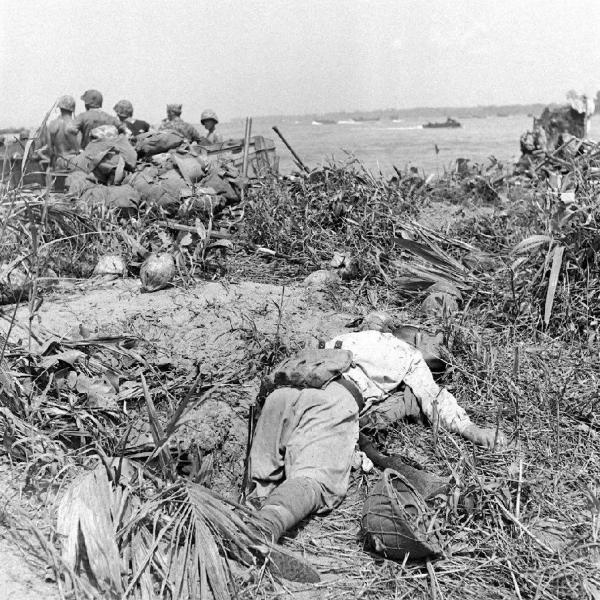
Silence again, then a sigh. “Seen a buddy die. WW II, South Pacific. One minute he was next to me talking, next minute he was dead.” He seemed like he wanted to go on. I stopped what I was doing and gave him my full attention, inviting him to continue.
“We were crawling, crossing a clearing. I was on my belly when I saw the ground sort of twitching or something in front of me. Little puffs of dirt. At first, I thought it was bugs jumping through the grass. I must have watched for a minute or so before I realized it was bullets hitting the ground from a sniper. He was far enough away we couldn’t hear the shots. I turned to warn my buddy, but he’d already been hit. A round had torn off his face.
“I was too damn mad to be scared. I should have been, but I just laid there, looking into the jungle. It took me a few minutes to figure out where the sniper was. He was hiding behind a tree, peeking out to take his shots. I took aim at where his head would be, and when he leaned out to shoot, I pulled my trigger.
“I yelled that I’d got him, and ran up ready to finish him off if I needed to. He was still alive when I got to him, but he was dying fast. The shot had hit him in the throat, and he was all sort of blue and making gurgling sounds.
“He couldn’t have been more than eighteen, just like me. I’d shot my weapon at the enemy before, but as far as I knew, I’d never actually killed anyone. I just stood there looking into his eyes until he stopped breathing. I’ll remember the look on his face until my dying day.”
His face had contorted again into that expression he had worn when I had first seen him, conveying an eternal sadness that he had somehow grown to be at peace with. I tried to imagine what he was remembering, but it was beyond my ken. He had been to war, and thanks to him and thousands of others like him, I had not.
I moved on to other patients while the nurse wrapped up his knee and discharged him. I was standing at the desk reviewing a chart when he sauntered past me towards the exit, the limp he’d had coming in replaced with a Mr. Bojangles-like spring in his step.
“It feels great, Doc. Thank you,” he said.
“My pleasure,” I said.
The limp would return, of course. The effects of age on a human body are inexorable, and the powers of physicians to hold them at bay limited. When one battles with the Grim Reaper, one does so with the certain knowledge of who will eventually emerge victorious.
But every once in a while, one can offer something, even if it is only a brief respite from pain, to a deserving soul.
And tonight, that had been enough.
Published U.S. Legacies Dec 2002
- Log in to post comments