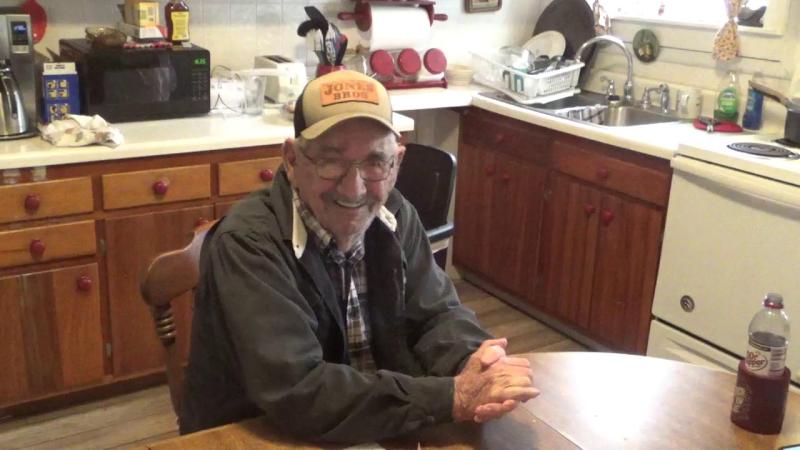
Interview with Jay Allen Doyle 3-19-25
Q: Where were you born?
A: I was born right here in Spencer County. So was my sisters and my dad. Dad’s full legal name was Jay Oscar Doyle. His nickname was Pat. My mother was Edith. My grandpa built this place.
Q: What do you remember from your dad?
A: Do unto others as you would have them do unto you.
Q: Was your dad a Christian, did he read the Bible?
A: No. My mom was. She went to Grandview United Methodist Church.
Q. What find of work did your dad do?
A: He was a farmer, of course, they milked cows. That was about it.
Q: Did he ever tell you anything that he did as a boy?
A: Yeah. He had a shotgun, and, uh, he said he would go down along the creek and run rabbits out of the creek, you know, or along there and my grandpa would shoot them. We kinda joked about it.
Q: Do you have any artifacts that belonged to your dad? Anything that was in the barn, or anything you kept? Keepsakes?
A: The only thing that should have gone to me, but didn’t was, they had a Bible, a heavy Bible, and in it, it had things that were of the past. It’s like, my grandpa had two or three brothers and they were on the Ohio coming down here and they had to stay in Louisville, cause one of the brothers had to be hung, cause he killed somebody there in Louisville. That’s what I was told. I don’t know. Man, that’s a long time before me. I don’t remember seeing my grandpa. He passed away in 1948. That made me 5 years old.
Q: Do you know what your grandfather’s name was?
A. Yeah. John Martin Doyle. No . . . John. Other than that, I can’t say. It’s on the tombstone up at Highland Cemetery. (Edit: Per gravestone. John Martin Doyle.)
And he married a woman named May, that lived right down the way, between here and Finch Hill. And she had a baby, and they both passed away. So he married her sister, which would have been my grandmother. Her name was Cora May. May was her last name. And that’s, I don’t remember her, or anything.
But, see, that was my aunt, Dad had sisters and one of them was . . . I’ll think of it in a minute . . . She married a Trumper. Cause I remember the uncle, you know. And then he had one by the name of . . . Clair, that was her name, Clara. That would have been my Aunt. And she married a Tremper. And he worked in Evansville at a factory on the west side. It was a drug place. It went over the highway, connecting 2 buildings. Johnson & Johnson/Bristol Myers.
Q: What kind of work did your grandpa do?
A: He worked on oil well rigs. That drilled wells.
Q: What was your Mom’s maiden name?
A: Robinson. From Grandview. I know where she lived. I know where she was born. OK. You’re going up 66, they always called it, it’s 800 East, Township line. On this side of township line. Raaf owned a place up there, and back on this side of it, they lived in a little ole house back on the hill. And the water would always come up, backwater would come up and they couldn’t get out. But there was a road that went behind them that came out over at Kenny Jones’, they called it Owl Town. That’s where they could get out.
And she had a sister, Lucille. I can’t remember my other two Aunts. And she had a brother by the name of Major, and the other one was Kermit.
Kermit had 3 boys, or 4. Jack Robinson was an attorney. Dale was the oldest and he moved out west. And there was Mark, a year older than me. And Mike.
Jack married Theresa Miller, she died of cancer. Jack passed away last fall. He was an attorney there in Rockport.
Q: As a kid growing up , do you remember any games you played, special gifts you received or any special memory?
A: No. I had 3 sisters. That’s what I was going to tell you about that Bible. The oldest, my mom gave my oldest sister this Bible, and I never did see it after that.
Q. What were your sisters names?
A. Patty, was the oldest one. She was 94 when she passed away. And then there was Cora May, was next, 13 months later or 14 months. And she married Richard Palmer from Troy. And then there was Carol, she’s 10 years older than I am. And she died from leukemia.
Q: Was your dad ever in the military?
A: He wasn’t. He had his papers to go, you know, for health, but he never, it was over and he didn’t have to go.
Q: Did you serve in the military?
A: No.
Q: Do you remember how you used to celebrate Christmas as a kid?
A: Go out and chop down a cedar tree. And it had to be the right size ‘cause you had this old gear and it had to stay, fit in that gear.
Q. Do you remember the first car you ever owned?
A: Yes. It was a ‘58 Chevy.
Q. Was it a hardtop or convertible?
A: It was just a plain ole car. Del Ray, the cheapest you could get. As a matter of fact, we raised tobacco. And dad always gave me 6/10 of an acre, or one patch and that’s what I bought that car with, was the money I got from that tobacco.
Q: Tell about planting, maintaining & harvesting tobacco.
A: It was a year-round job, raising tobacco. First, you had to find a place where you could burn a lot, and that’s where you would put your plant bed. During the winter you would cut the trees down and everything. And then you’d burn it. ‘Cause that killed the weeds and everything.
And then you’d sow the seed that was like, it was a real fine seed, real small. And you had a canvas, you would cover it up. Then, after it got up, you would remove the canvas and they grew.
Then you had to pick them plants out of the beds. Before that, you had to have a place to put your tobacco to raise it. And that was what you done the last (undistinguishable) you’d sow rye and you would take the plow and plow it under. And that was where you grew the plants at.
Q: How did you dry the leaves?
A: Up in the barn.
Q: In your barn here?
A: No. We didn’t have enough room. On this side of Grandview, you go over Finch Hill, that old barn to the right, that’s falling down. They had 3 acres of tobacco in that patch, and we done that. I mean, we had that barn full of tobacco!
And, the strangest part of it is, Catherine Montgomery and my mom (Edith Doyle) could not wait until it was time to strip tobacco. Them two, it was something they looked forward to all year long. And my dad had a place they could get in, and he would throw his tobacco down out of the barn, and take the stake out and those women would take and pull the leaves off the stalks.
Q: Do you remember how much money you got from tobacco?
A: No.
Q: Cause you said you used it to buy a car.
A: Yeah. I’d say $600 - $700. From 6/10 acre.
Q: That was from one year?
A: Yeah.
Q: So the car you bought, was it new or used?
A: It was used.
Q: Did you ever play any musical instrument, sing or anything like that?
A: No.
Q: Did your grandparents or parents play any type musical instruments?
A: Cora May played the piano. My oldest sister, Patty, played the organ. And she would play it where she attended Worship Services at a church building there in Evansville.
Q: Do you remember where they took lessons to learn?
A: There wasn’t any such thing, I don’t think. (Laughter.) That was the front room in there, and the only thing in it was the piano. And the floor went like this. (Indicated slope.)
Q: You talked about how they built the underside of this house. Describe that.
A: It’s built on brick. I was so amazed. We didn’t have a floor like this, we had linoleum, and the wind would blow, and the linoleum would come up, and my sisters would find a chair to sit around on the linoleum to hold it down. (Laughing) I’ll never forget, I loved that.
Q: You talked about how it was set up on brick, it was a good foundation?
A: Yeah. It was a big ole hunk of wood, 12”x12” maybe, hand hewed, cut the bark off, you know, and they sawed it.
Q: You talked about the piano and organ, what type of music did you listen to while you were growing up?
A: Hank Williams. Country radio. That’s all we had was a radio. And it was the “Grand Ole Opry.” Remember that? And remember when they came out with wrestling? Montgomery’s bought a television. And I used to go over there on Sunday evening. And the television was round, not very big. And snowy, you couldn’t hardly make it out. And then I wouldn’t come home to do the milking, cause I’d be over at Donnie’s watching television. Donnie Montgomery’s.
Q: Describe the type of radio you had in the house when you were young. Was it battery operated or did they have electricity?
A: Later on they had electricity. Before that, there wasn’t anything.
Q: If they didn’t have electricity, describe your old “ice box.”
A: I don’t remember. We had one and it sat right there where the refrigerator is. We would go to Rockport to get a hunk of ice. We transported it back home in a horse drawn wagon.
Q: Did your dad own a car? What kind of car was it?
A: Yes, he had a car, but I don’t remember what it was. I do remember that this well out here, he dug it by hand. It was 103 feet deep. He made everything to work.
Q: How did he drill it?
A: He had this old car and he had a place where he backed into, jack the car up and put a belt on it, and that belt would run the drill. My mom said that he would sit out there all night long, sleeping and drilling that well. But the first thing he done when he came home out of the field, he had a barrel he put up in the back end of a wagon and took it down to the creek and get water. He would get a barrel of water. I don’t know if it was a 55 gallon barrel or not, but he would have enough water to do him that night. Then, they would milk the cows, eat supper and then he would go out there and get everything rigged up. But he made everything himself. He made his own jack, he made everything himself. Where he got the casing for, it’s out there now. It’s 8 or 9 inches, I don’t know where he got it. But he made his own bailer, he made everything himself.
Q: Did he weld?
A: No it was all locust posts and wood. It was all wood. It was something that they had to do at that time. Like making a wheel for a wagon. Think about what had to go into that. You’ve got this old wheel. What, maybe 4 to 5 feet high. You had the spokes, you had to have a hub, you had to have everything. He would make everything out of wood, then you would find a piece of metal to make a rim to go around the outside of it. And he could take a piece of metal and make just about anything he wanted to make. He’d just build a fire, and like a forge.
Q: When you were growing up, did they have any public events around the town or county?
A: Grandview Fall Festival. They would block off Grandview, St Rt 66, and the County Fair at Rockport. They had car races and all that. Horse races, horses pulling sulkies, in the daytime. They had the rodeo. I can just barely remember, dad went to the rodeo, we went down there. And they came out over the speaker, if anybody wanted to ride that bull. And one of the Grose’s, I don’t know who it was, went down there and volunteered to ride that bull. The bull throwed him off and like to killed him.
And dad, drank beer naturally, and somebody came in down there at the tavern and was laughing about how stupid they thought it was for that Grose to get out there and try to ride that bull. And the way I understood it, my dad like to killed him. Throwed him out in the street, and I guess knocked him down and kicked the s**t, I mean just beat him.
Q: How big was your dad?
A: A little bit bigger than I am.
Q: I notice you’ve got a real nice pond right outside your door. Who dug that?
A: Me. I dug it with an old wore out backhoe, and an old dump truck. It took me ALL summer.
Q: That was for your cattle?
A: Yeah. My mom always wanted a lake there. ‘Cause, see, it was just a gully with an old chicken house down there. She always wanted a lake, so after I moved up here and retired, I just decided I was going to build one. I took junk and done it.
Q: “After you moved up here.” Where were you living before you retired?
A: Madisonville, Kentucky. Before that, it was Paradise, Indiana.
Q: What kind of work were you doing down there?
A: Mechanic work. Mechanical work. Earth moving equipment. They call it Diesel mechanic.
Q: How did you learn your trade?
A: By hand. No, I take that back. I went to Nashville Auto-Diesel College.
Q: How did you have the money to pay for your college?
A: Tobacco base.
Q: What kind of knives did you use to cut the tobacco?
A: Hatchet. And dad would drive the stakes, and you had this real sharp, a piece of tin that had a real sharp point on it, and you would put it over the stake. You would cut the stalk and then take and put the stalk and put it over the stake that had that sharp end on it that would split the stalk. Originally, they took a knife and cut the side of the stalk and slide it over the stake.
Q: Talk to me about when you started dating your future wife. What was it like to date in that era? What kind of places did you go?
A: Well. Billy Goat Hill.
Q: How did you meet your wife?
A: Through her brothers. She had 3 brothers and we used to go frog hunting. Lola Jean Ryan. She was from up on Highland. She died, in June it will be 5 years. Just something we all have to go through. She was a wonderful woman. And, damn, I worked many a many hour.
Q: Any memories of something that stands out in your mind, that you are proud of?
A: We had an old Formal tractor. They called it an F30. It didn’t run. And I was going to rebuild it. Of course I took the bolts off, the head, everything. I remember working on that. And I finally got it running. It took me all summer. I guess I was in high school.
Q: How old were you when you moved out, went to college?
A: 18 or 19. One year I was going to play football. One of the fellows was going to come get me. He lived down there by Richland, Jim Reiniger, and his dad broke his leg. So we wasn't able to do that. So neither one of us got to play football.
Q: What made your wife special to you?
A: The thing that made her special, was our wedding. Till death do you part. We were married at Fairview Church, but I don’t remember the preacher’s name.
Her brothers were, Bob, Bill and Richard or Dick Ryan.
As a kid, I rode a bicycle to Grandview. I’d get a loaf of bread or a gallon of milk. There were 2 grocery stores in Grandview. One was Kruse’s and the other one was Claise’s, on the corner where the bank is now.
Q: What other businesses were in town?
A: There was a filling station. Well, 2 of them. Bob Phillips and Elno Titus. She always dressed up like a man. And 2 or 3 taverns. A pool hall. Purina feed store. Porters Drug store. A barber shop, and the Library. And Cap Dawson’s Garage.
I want you to read this. (Story from His Touch, His Glory)
Mudhead. That what they called me when I was a little kid. That’s my sister there. She died when she was 93.
Reading: “ As it was with Cathy and Jill, Angels can be seen, others are unseen, but undeniably felt as warm sensations. In fact, it wasn’t until Pat Smith, figuratively warmed up to God, that He literally warmed up to her. Blanketing her with an assurance that everything was going to be okay.
“As a 38 year old in 1968, Pat made multiple trips daily to visit her 25 year old brother Jay, a diesel mechanic, who had been involved in an explosion.”
Q. Tell me about the explosion.
A. See the hole in my forehead? A barrel of lacquer thinner exploded. It blowed up and burnt over 70% of my body, second and third degree burns, and broke my arm in 2 places. It’ll tell you in there.
Resume reading. “Jay, a diesel mechanic, was involved in an explosion at a machinery supply company.
“In addition to suffering second and third degree burns over 75% of his body, he had a depressed brain concussion, and an arm broken in 2 places.
“”Once you smell burned flesh, you never forget it,” Pat said. He had 19 skin grafts. The difficulty of having to cope with a loved one experiencing horrific pain, frequently drew her into the hospital chapel. “I’d spend two and three times a day in the chapel, praying. I’d pray, God, if my brother will be okay, and if it is your will, please let him live. But, if he won’t be a person that can live a normal life, then, God, don’t let him live. Let it be your will.”
“Pat was often accompanied to her brother’s room at night by his wife, Jean. One of those nights brought an unforgettable experience. Five or seven doctors came into Jay’s room and said he wouldn’t live.
“I was standing beside his bed and it was so cold in there. They had him in cold storage. They kept him totally wet all the time, no clothes on, just all wet. I had on a sweater and a wool dress, and I was freezing in there.
“All of a sudden, the room got really, really warm. I said to Jay, “Honey, you’re going to live, and you’re going to be okay.” Pat wondered if Jean, who was standing on the other side of the bed, had experienced the distinct warmth.
“As we left the room, Jean started crying. That was the first time I had ever seen her cry. I asked her if she felt it, and she said yes. It was right then and there that I became a real, true Christian.”
End of reading.
Jay talking. Most people don’t know what pain really is. We’ve all hit our finger with a hammer. But, you don’t know what it’s like. They kept me sedated for over six weeks. They always said, that it didn’t matter where you were at, if you were on that floor at Deaconess Hospital, you knew where I was at. Cause I was cussin’. Lola Jean told me that I cussed with every breath. I always thought I could never be still. They would tie me down, and I would break loose. I’m gonna tell you something I don’t tell very many people, but you’ve heard of the tunnel, I went down that tunnel. And at the end of that tunnel, as I was moving down it, I could see a light, like a dusk to dawn light, a white light, and I felt at that time, and it might have been that, that I didn’t make it to that tunnel. That’s as close as I want to go.
Q: I’m a firm believer that some people are selected to stay alive.
A: And I felt that way and after I got home, and this happened in December 1968, I guess I went back to work in September or October 1969. I don’t know . . . you . . . something . . . and I started to attend worship service and something that really upsets me in a way, and in a way it don’t. I think I’m wrong, people say you go to church. You don’t go to church. You go to worship God. You are a member of the church, cause in Matthew, not Matthew, Acts, Christ said, “Upon this Rock I will build My Church. And the Gates of Hell shall not prevail against it.” But people don’t understand that. But you preach your own life, you preach your own funeral while you are alive. Ain’t nobody gonna put a hand on the Bible and put you in Heaven or put you in Hell. You gotta do it on your own.
And I’ve had my share. I’ve had one more that’s as bad as this was. It didn’t last this long. Only lasted a week, but . . . I had a brain tumor. I kept having a knot pull up on my cheek. So I went to that doctor down here in Rockport. He had to go up to Tell City and get x-ray. They found that I had a brain tumor. Well, Sherman, he had a Neurosurgeon meet me over at Owensboro at the hospital. And Lola Jean and I went over there, and he looked at the x-ray and everything and he said,well, it’ll have to be done in Louisville. I said I thought you were the Neurosurgeon. He said, Mr Doyle, There’s not that many of us, and there’s none in Evansville smart enough. So, I had to go to therapy. The appointment was, I don’t remember what year it was, but anyhow, I went to therapy every day over in Owensboro. I went four days a week for therapy. We’d done been up there to Louisville to talk to the Neurosurgeon, and he told us that he didn’t think that I could live through what was going to have to be done. But I had to get my breathing where I could bring in more oxygen. So I done this, and went up there. It’s real . . . It’s real strange what your body, what your mind thinks. You think, My God, you’re gonna take my brain out . . . I mean, what would you think about it? A doctor tells you, we’re gonna have to operate on you, you know.
Well, I went up there like I was supposed to, and the kids all came, and their wives. And it came time to go, you know, I kissed Jean . . . it’s hard for me . . . cause I didn’t think I’d live.
So, they took me in . . . And when I came back into the room, and I got my p’s and q’s, you know, my head was . . . dang, it hurt! And s*it was running out of my eyes, my ears . . . kinda a bloody-ish looking, you cut your finger, you know how it looks, it’s blood but it’s got a white kinda, you know.
Fella came over, nurse came over to the bed and looked at me and my wife and all the kids had to leave the room. Fella came over there wanted to do tests on the sides, you know. Two more nurses and two doctors came in. One doctor said I had to lay down, the other doctor said I had to stand up. Stand up or lay down. Not many people know this, but I couldn’t stand it. It hurt, and I passed out.
And then later on, maybe the next day, whenever, I did come back around. And, I couldn’t see. In other words, I could look at you, and there would be another of you down here. I could look at the front of your car, and there was another one right there. And I thought, I told Jean, I said, “Dang it hun, they screwed up! Something is wrong with my brain.” And then the brain doctor, the Neurosurgeon, came in.
Told me, he said, well Jay, You had a lot more than we expected. I said, What was it? He said, That tumor had grew into your eye socket. And we had to remove your eye and your optic nerve to put titanium and build you a new eye socket. And he said we had to, couldn’t put the your optic nerve just exactly the way it was. Well s*it. You know. Well, it didn’t get no better. Finally got the okay to go to therapy over here in Owensboro.
My wife, she made me a patch to put over my eye. It didn’t matter, this is what’s weird, it didn’t matter whether it was my left eye or my right eye. I could see alright with one, but with both of them, I seen two.
They put me through therapy and all that, you know, and I don’t know, it was stupid. And then I had to, they put me down to the Nursing Home here in Rockport, and I went in there for a week. And then the doctor said it would take 6 weeks . . . 6 months before I would be able to see again. And he was right. And now it’s coming back again. In other words, when I’m driving, like there’s a car coming, instead of 2 headlights, there’s 2 up here and 2 down here. But I can compensate for that.
But that left eye really screwed me up. But it was very, very painful.
Q: God definitely had plans for you, kept you alive.
A: Why else? He had my number. You know we all say we got a wrong number. He didn’t take me. In all this, I was off for 3 months. When I first put my feet back on the . . . down, the blood going into my legs, you talk about itching! My Gosh!
Then I had kidney stones. They would put me, see each one of my skin grafts, they would last for 2 weeks. They would put me on a gurney and put me down in the water. Where they took the skin from, they had it patched, you know, and they had to soften that up before they could remove that bandage. And I told that fellow, I said, that was letting me down in the water, I told him, I said, “If I ever get hold of ya, you’re gonna swim like I am!” All they had was my mouth sticking outa the water. And Dang, that hurts. 103 degrees, the temperature in that bath.
But then they removed the kidney stones, then later on , I came home, I was doing better. And my right nut swelled up about the size of a softball. My Gosh! That hurt! I had to go back in. And through all that, they left me lay, they had the catheter in too long. My penis was burnt and it got infected and it wouldn’t heal up. Then I had to, they put a tube in my bladder and they though that maybe if they left it alone, it would heal up on its own, and it wouldn’t. It had to be operated on. That ain’t no fun.
Then I had kidney stones again. Like I said, you don’t know what’s in store.
Q: They say God won’t give you more than you & He can handle.
A: And Dang! He had me right on the edge!
Q: You said that happened to you in 1968?
A: Yeah.
Lola was, we went over to . . . she was gonna have x-rays. We were screened in over in Owensboro. And she had a seizure. And my oldest daughter, she was there. And they had the ER come and take her to the hospital there in Owensboro. But she started kinda going down hill a little bit that time. And Kim Hay is the county nurse, that’s her niece. Kim is Linda Ryan’s daughter. And she would come twice a week and give her shots. And it kept . . ., you know how things are.
We didn’t know what to do. And we went up to the cemetery up here, you know. She was raised in the house right there by Highland cemetery. And she picked out the place where she wanted to be laid. Then we came back home and things got a little bit worse. The kids finally all of them came. And Janice and Christa, they stayed with her. We called Hospice and they brought a hospital bed, which made it easier for Janice and Christa to change the, what has to be done.
Kris Hale brought his camper over here and put it in the front yard so that if anybody wanted to stay overnight, they had someplace to stay.
I don’t know how many days it was, it wasn’t very many, like 2 or 3. and my sister-in-law woke me up, I was out there in the camper. She said, “I think it’s time.” So, I came in there, I got her left hand and I held her. And Kim got my left hand. And we could tell, the breathing was getting more shallow, now this is, it may be hard for you to believe, but I swear to God, she just quit breathing. I told Kim, “Well, we’ve lost Jean.” Kim said, “No. Not yet.” Now how Kim knew, I’ll never, never know.
Lola took one more deep breath. That time when she exhaled, she closed her mouth and a great big grin came on her face. She smiled, and I felt, at that time, when she smiled, she was in Christ’s Arms. Why, what other way, cause never before she never did close her mouth. But there was something that was just different.
And you don’t know how much, after your mate is gone, how trivial things are. That’s just like the yard, the dang limbs out there in the yard. Ordinarily, I would go out there and pick them all up. Now, I don’t care if there’s a dang limb out there in the yard or not. That doesn’t interest me a bit. Things that I thought were so dang important, ain’t no more.
And she wanted a closed casket, because she had wrinkles. She had a tit removed, her hair never did come back in all the way right, that didn’t bother her a bit. But she had these wrinkles. She was so embarrassed that she had wrinkles. And when she laid in there, when she passed away, there was not a wrinkle on her face no where. The were gone.
Now, how can that be? How can anything . . .
Q: Anything is possible through God. Anything.
A: Well, I think she proved it to me.
Q: There is so much that we don’t understand, and won’t until we see Him. Your testimony, right there, about things you went through and that God saved you multiple times.
A: Just like I told you earlier, We preach our own funeral all of our life. You don’t know how many times, I wondered, “Why didn’t I go on?” or “Why did I turn this way?”
© Copyright 1996-2026 U.S. Legacies and American Legacies Org, Inc.
All rights reserved. No part of this story may be reprinted without the prior consent of U. S. Legacies, American Legacies or the original author.
- Log in to post comments