
By Kathy Warnes
Reverend Ernest Norquist of Milwaukee, Wisconsin, describes his draft status in 1941 as “being under the threat of the Selective Service.” He decided to enlist in the Army so he could choose where he could go and his choice was the Philippines.
After he became a medic, he served as a ward man at Fort William McKinley, about seven miles from Manila. Within days after Pearl Harbor, the Japanese started landing in the Philippines and casualties began to pour in. Reverend Norquist recalls “toward Christmas we knew we were going to evacuate. On the way back from church
I remember that we passed a convent run by some American sisters who gave us cocoa and compassion.”
On December 29, Reverend Norquist and his unit moved to the Middleside Hospital on Corregidor, which is a tiny island at the entrance to Manila Bay. There was a Middleside, Topside, and Bottomside hospital and a trolly car running between them. The entire fortress at Corregidor was designed to protect the Bataan Peninsula and was comprised of one main tunnel hewn out of solid rock and several laterals.
Reverend Norquist was one of the eight medics who worked on casualties while the bombing went on around them. He remembers one time when the hospital was being bombed. He had been about to eat a piece of butterscotch pie, went downstairs for shelter, and eventually returned to the table. He couldn’t eat the pie because it was full of plaster.
The American Army continued to fight on Corregidor, but it was decimated by malaria and ran out of water. The last American garrison surrendered on May 7, 1942, after surviving 53 air raids. General Jonathan Wainwright, the Army’s commander at Corregidor, announced the surrender. Reverend Norquist recalls, “I felt an infinite sadness when the General surrendered and all of us put up the American flag and saluted it. We cried at the white flag of surrender, because I think we all knew that we wouldn’t see the American flag again until we were freed.”
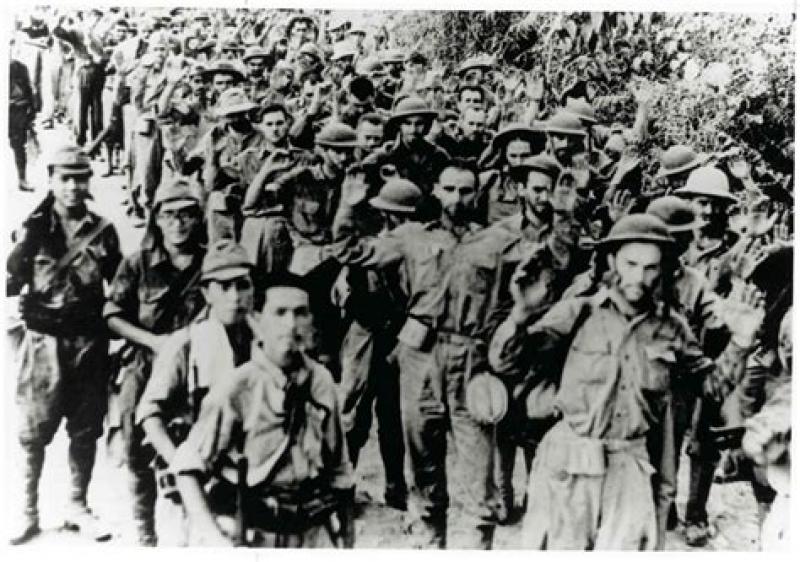
The next step for Reverend Norquist and many of the men was marching up the Bataan Peninsula as part of the infamous “Death March.” By now, Bataan was a swarming mess of bewildered Japanese, Filipino and American men. Japanese intelligence estimates of the number of prisoners were far too low. There were actually about 78,000 U.S. troops, 6,000 civilian employees who had been rushed to Bataan to build defenses, and 26,000 civilians. The Japanese had been expecting only about 40,000 people. The captured men had to walk long distances on foot under a tropical sun. Sick and wounded were killed by guards at the roadside, hundreds at a time. More than 7,000 of these prisoners died on the Bataan Death March; one-third were American and two-thirds Filipino.
Reverend Norquist was nearly killed on the march. He fell behind and sat down. As he puts it, “I saw two Japanese soldiers coming toward me in a very business-like manner and I got up quickly.”
One of the initial stops for Reverend Norquist was Billebub prison in Manila for a few weeks and then to Cabana Tiwan, where the prisoners were placed in barracks that had been occupied by the Filipino Army. Here, Reverend Norquist continued to put his medic training to work. He remembers what he calls “death parades,” where men who had died were carried out on window slats or shutters torn off the building. The death parades diminished when the Swedish Red Cross Ship “Gripsholm,” brought supplies to the camp.
In the 26 months that he spent at Cabana Tiwan, Reverend Norquist helped build an airport that was never used, became acclimated to POW life, and became more and more certain that he would become a minister if he survived. He saw the examples of the Army chaplains and a Filipino priest who risked their lives to help the prisoners and felt that the church might be a calling for him.
In 1944, the Japanese moved the prisoners to Japan on a ship called the Noto Maru. From Tokyo they were taken to Omari Prison Camp, which was located on a tiny island. Reverend Norquist vividly recalls incidents of prison camp life. The men were amazingly resourceful. They improvised musical instruments and formed an orchestra. They put on plays, including Shakespeare, and even had a school.
The turning point in the war seemed to Reverend Norquist to come in 1944. There were bombing raids and fire storms, with huge areas of Tokyo being burned. “I felt a great sadness for the Japanese people,” he admits.
Once again the prisoners were moved, this time north to Wakasennin, a place of temples, tori gates, and windows of mother of pearl. Here they worked in a pig iron factory and on farms. Finally, the day of liberation came. All of the prisoners were brought out to the parade ground. Reverend Norquist remembers exactly what the British soldiers who made the announcement said: “Gentlemen, the day for which we have long awaited has at last arrived. You are free men.” Then there was an immense hip hip hooray.
The Japanese commander made a speech next and said that he hoped that everyone would get home safely. The men were warned not to go into the Japanese village, then they were dismissed. Immediately, they went into the Japanese village and a little Japanese girl about six years old handed Reverend Norquist a doll. A Japanese man brought out a family album and insisted that he choose some pictures to keep.
Because of the influence of the war time chaplains, Reverend Norquist decided to become a minister. After the war he studied for the ministry in Lund, Sweden and was ordained in the Presbyterian Church.
Reverend Norquist had another encounter with General Wainwright, this time at the Cadillac Hotel in Detroit while he and his wife, Jeanette, were on their honeymoon. General Wainwright had quarters on the eighth floor and “I tried to get in to see him, but his orderly wouldn’t admit me,” the Reverend says. “Then I heard him say,’Is that one of my boys?’ “I said, yes sir, and he came out and spent half an hour with me. He really cared about the ordinary soldier.”
In Reverend Norquist’s opinion, he learned two important principles from his POW experience. The first was that the war transformed most people’s lives. It was the biggest thing that ever happened to them and helped them transcend themselves. The second principle was: “You can’t put together people of different cultures and have them hate each other all of the time. When I wanted to get bitter and hate the Japanese, I would remember them sitting around a campfire singing a hauntingly beautiful song called “The Moon Over a Ruined Castle.” I couldn’t hate them.”
Published U.S. Legacies December 2003
- Log in to post comments