Okinawa Saga

We really had a bird's eye view of front line combat. We were using a 20 power tripod mounted spotting telescope and maps and a phone back to Hdq Company.
- Read more about Okinawa Saga
- Log in to post comments
We really had a bird's eye view of front line combat. We were using a 20 power tripod mounted spotting telescope and maps and a phone back to Hdq Company.

The soldier in this story can honestly say that he only enjoyed two meals during the 2½ years of his military service and they were both on Christmas day
In 1948 the men of the 139 Static Bakery unit assembled in the cookhouse where they anxiously awaited a meal delivered to them by officers, which was the tradition in the British army for generations.
Fifty-six years later, Billy tried to express his feelings about that afternoon in the tent on Christmas day 1948 and every time he thought of things to say, tears came to his eyes and he had to move on.

Wartime Memories: Operation Varsity
I was a POW January 6, thru April 29, 1945. There was a lot we missed out on in those days as POW's. We were on a 95 mile forced march in 1945 between Nurenburg and Moosburg.

I was assistant communications officer of a non-divisional heavy artillery group (the 52nd). As such, I had the time for, and was frequently assigned, a variety of extra duties. One time-consuming and paperwork-intensive task was that of survey officer. That is, I would be assigned to investigate the loss of, or serious damage to, government property.
I was assigned to do the required Report of Survey when the 52nd Group Commander's driver wrecked the CO's jeep. This hot potato involved a kid who was extremely popular around the headquarters but who had wrecked his jeep while, as far as I could tell, drag racing.

The 145th was isolated from the main army and in constant danger of falling victim to the enemy's cavalry which was very active. The 145th filled a gap which existed between the Union right and the Potomac, holding the two paths and the road which ran along under the high bluff skirting the river.
This prevented the Confederates from flanking the Union forces in that direction. The 145th held its position until the morning of September 19, 1862. That morning the Yankees discovered that the Rebels had escaped. In company with other troops, the 145th went to the field to bury the dead and care for the wounded. For four days the wounded and dead had lain as they fell and left an intolerable stench in the air.
The men of the 145th grew sick from privation and exposure and the severe duty on the polluted battle field. Within a month from the time the 145th had been ordered to the front, between 200 and 300 men were disqualified for duty. Many men died or were permanently disabled or discharged.

While on a billeting party, I parked my jeep in front of a building that I wanted to check out to see if it was suitable for the company command post, (CP). When I came out, I was surprised to find two Germans looking over my jeep. They were just as surprised to see me and for a moment it was a stalemate. I didn't like coming face to face with armed enemy soldiers but since I had been trained to react, that is what I did. I pulled my Tommy Gun up at waist height, took it off of safe and stood my ground. The enemy soldiers had their rifles hung over their shoulders and it did not appear that they were ready to fight.
I put my finger on the trigger and waited. The Germans said something to each other that I couldn't understand. They started to take their rifles off their shoulders and I thought, "This was it." The one German could speak English and he said, "You in 14th Panzer Division?"
To that, I replied, "Yes."
"Do you always feed German Prisoners before they are locked up?" the German asked.
I replied, "We try to feed them if it is possible." The German said, "We surrender, the war is over." With that comment, they took off their steel helmets and tossed them to the ground. This was always a signal to us that they didn't want to fight anymore. They unloaded their rifles and leaned them against the jeep. They put their hands behind their head.
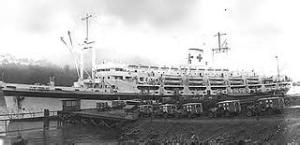
By Mary Lewis nee Smith
I became a RN from the Oklahoma General Hospital (later Mercy). and joined the AMC, ( Army Medical Corps) in 1945, then served in the South Pacific.
When I went over to the Philippines. I was on a ship called “Comfort". The ship was late in picking me up. When I got on board. I talked with a man who had already been on the ship and found out the reason they were late was because they had been hit by a Japanese Suicide Plane.